City Gov Involves Community to Realize Low Emission Areas
Reported by Aldi Geri Lumban Tobing | Translated by Nugroho Adibrata
The Jakarta Government, along with the Breathe Cities Jakarta program, strengthens collaboration with the community to support the implementation of Integrated Low Emission Zones (KRE-T) as part of the commitment to create a healthy and sustainable city.
The role of the community is also a key factor
This effort is aimed at encouraging public participation in air pollution control that is more inclusive and evidence-based.
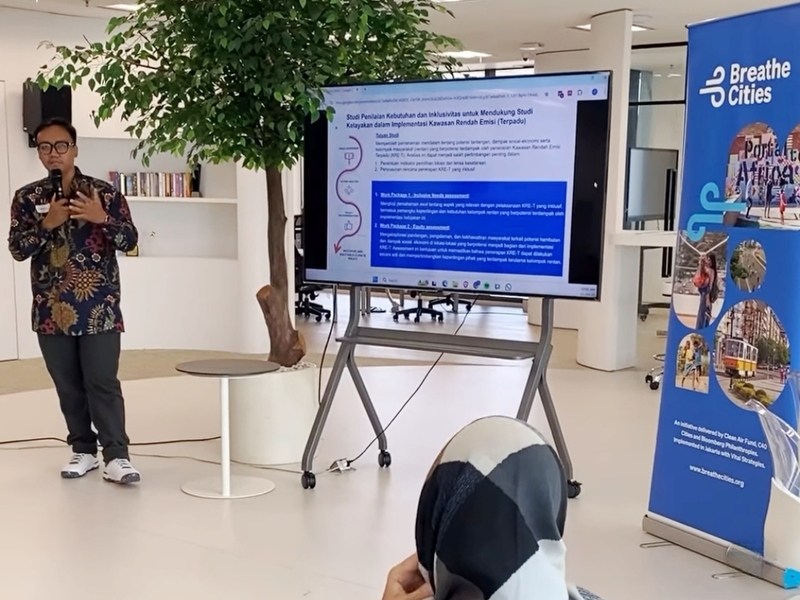
Breathe Cities program is part of a global initiative supported by the Clean Air Fund, C40 Cities, and Bloomberg Philanthropies, and is being implemented in Jakarta in partnership with Vital Strategies.
Jakarta Develops Integrated Low-Emission AreasBreathe Cities collaborated with the Jakarta Government, led by the Environmental Agency, to accelerate air pollution control through the strengthening of data-driven policies and public participation, one of which is KRE-T policy.
Jakarta Environment Agency Head, Asep Kuswanto, said the KRE-T policy is a strategic step based on Governor Regulation No. 90/2021 on Low Carbon Development and Climate Resilience Plan and Governor Decision No. 575/2023 on Air Pollution Control Strategy (SPPU).
"The success of KRE-T not only lies on regulations, but the role of the community is also a key factor in terms of oversight, public education, monitoring the impact of policies, and supporting vulnerable groups," he expressed, Thursday (6/19).
As part of this effort, Breathe Cities Jakarta and Environmental Agency gathered the community to align understanding and strengthen synergy among communities. The aim is to build more solid coordination in running collective actions towards clean air in Jakarta.
Together with the Resilience Development Initiative (RDI), Breathe Cities Jakarta is also promoting community-based air quality monitoring through the use of low-cost sensors.
"This technology enables the expansion of monitoring networks to residential and industrial areas that were previously unreachable by conventional monitoring stations," he continued.
He added, this initiative also emphasizes the importance of integrating hyperlocal data into official monitoring systems as a basis for formulating more precise and responsive policies.
At the same time, community engagement strengthens local capacity in understanding, interpreting, and collectively using air quality data.
"This multi-stakeholder collaboration is the first step to creating a blueprint for collective action. We want to ensure that the role of the community is not merely symbolic, but strategically integrated into Jakarta's air pollution control system," he stated.